Fernley, Nevada: 89408
- Nevada Postal Project

- Apr 13, 2021
- 8 min read
When we drive through towns in the West, we sometimes ask a pair of related questions.
Why does this town exist?
How does this town exist?
The questions are simple. The answers usually aren’t.
Why asks about the community in its environs. Why must there be a town here? What is this town doing here? What historical, topographical, geographical, cultural reasons are there for this particular town to exist in its present state, in its current location?
How asks about the mechanisms for the survival of the municipality. What are its major employers? Upon what industries does the town’s civic engine run? And, especially in the West, what resources of water, power, food, gas, and other supplies support its continued existence?

When we drove to Fernley, the second major excursion of the Nevada Postal Project, we kept our eyes open for answers to these questions. The first one remains murky. But answers to the second question – How does this town exist? - seemed readily apparent.
Interstate 80 runs through Fernley. This thoroughfare, which will play an important role in the Nevada Postal Project, bisects northern Nevada, following the routes that American pioneers - Gold Rushers and the ill-starred Donner Party among them – took to reach the goldfields and rich agricultural promise of California. Today, the route serves as a vital supply artery from Salt Lake City and regions east, as well as connecting the more remote communities in northern Nevada. Most folks who take 80 from Salt Lake City to Reno try to get through the trip - nearly eight hours of desert mountains, big sky, and salt flats – with as few interruptions as possible. Truck stops abound.

They especially abound in Fernley (elevation: 4160 feet; population: 21,476). The town boasts two distinct city centers: a newer one just off I-80 (complete with truck stop) and an older one, straddling the old US-40 route (complete with two truck stops). New Fernley gleams, fresh blacktop connecting chain grocery stores to chain fast food joints. Walmart and Raley’s elbow with McDonalds and Taco Bell, jockeying to snatch the quick-off-the-interstate traffic that’s only interested in a quick resupply before traveling on – west through the Truckee River Canyon to the Sierra Nevada, or east across the Forty-Mile Desert and into the hinterlands.
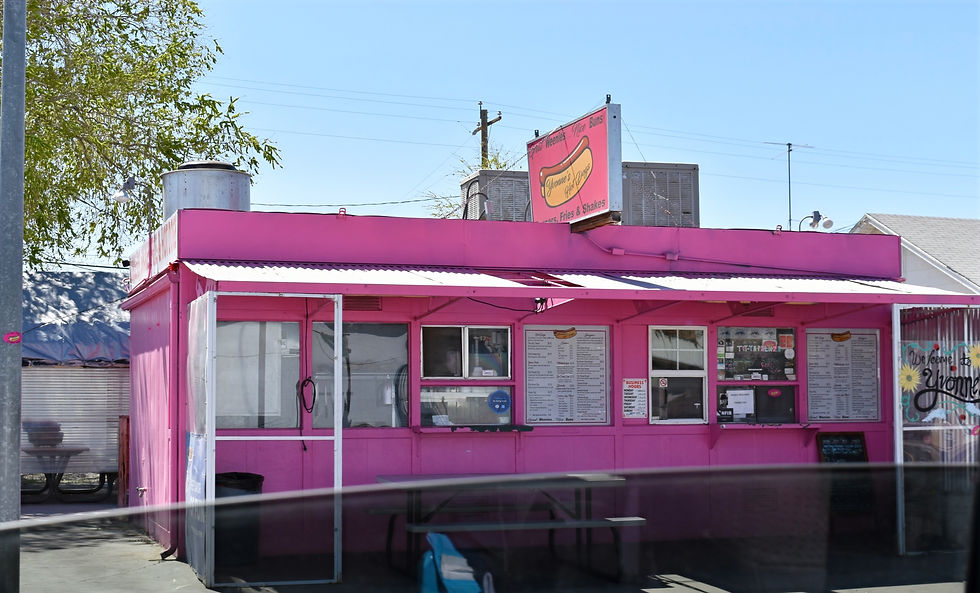
The second, older city center reminds us somewhat of Gerlach. The roads are well-kept but not ostentatiously new. There are fewer chains, more family-owned businesses – like the extremely pink Yvonne’s Hotdogs, pictured above. The (glittering-clean, apparently new) marquee out in front of the volunteer fire department shares well-worn one-liners:
WE PREFER OUR KALE WITHOUT THE K (westbound)
or
WHERE HAS ALL THE GOOD GRAMMER WENT (eastbound)
Mature trees shade civic buildings; we see a branch of the Lyon County Library, a sheriff’s office, and a campus of Western Nevada College. We’re not in Lyon’s county seat – that lies to the south, in the much older, much smaller town of Yerington. But riding Amazon’s meteoric rise, the more stable presence of the U. S. Navy’s flight training program, and of course a steady stream of stop-off business from the interstate, Fernley has become the most populous and busiest city in Lyon County.

That all might change soon, though. I-80 isn’t the only artery that has supported Fernley – the Truckee Canal has, for decades, accidentally replenished Fernley’s groundwater, making life possible in this riverless region. More than a century ago, Francis Newlands pushed the Reclamation Act through congress – so vigorously that the Reclamation Act is sometimes called the Newlands Reclamation Act. At the time of the Act, Newlands represented Nevada in the House of Representatives as a member of the Silver Party; the following year, he would be elected to the first of three terms in the U. S. Senate, as a Democrat. Simply put, the Reclamation Act provided for large-scale damming, diversion, and irrigation projects to promote farming across arid Western states. The phrase “making the desert bloom” recurs in contemporaneous descriptions of the project, alluding to Isaiah 35:1.
Modern Nevadans, if they know Newlands’ name at all, know him as the force behind the Reclamation Act. (He also happened to be a thoroughgoing white supremacist, who advocated for the repeal of the Fifteenth Amendment, which establishes non-white Americans’ voting rights.) The first irrigation project undertaken through Newlands’ Reclamation Act was the construction of the Derby Dam, which diverted water from the Truckee River through a newly-built canal, constructed with earthen berms, into Lahontan Reservoir. The water stored there would be used to irrigate farms in Fernley, Fallon, and their surrounding areas. This development had wide-ranging, unintended effects: it caused a local lake to dry up completely, very nearly led to the eradication of a trout species found only in Pyramid Lake (to the north), and began contributing 5.9 billion gallons of water every year to Fernley’s aquifer. (That's 18,000 acre-feet, or 22 million cubic meters.) According to a recent AP report, Fernley survives on an aquifer which has been replenished, accidentally, for more than a century.
So what could possibly threaten Fernley’s preeminent status in the region? Well, in 2008 that 106-year-old dirt canal burst its bounds, flooding hundreds of homes in Fernley. In response, the U. S. Bureau of Reclamation – which traces its origins to Newlands’ Reclamation Act of 1902, and which administers the Truckee Canal – has moved forward with plans to line that dirt canal with concrete for safety. Dirt allows for seepage, at the rate of 5.9 billion gallons a year; concrete seeps much, much less. If the Bureau of Reclamation goes ahead with its concrete-lining plan, one out of every ten wells in Fernley will run dry within a year; the majority of the region’s wells will run dry in the next half-century. This town lives on borrowed time.

How does Fernley exist? On the stopover dollars of long-haul truckers and cross-country drivers; on a commuter exodus from nearby Reno’s exorbitant housing market; on Nevada’s gamble to lure big-name tech companies with cushy tax breaks; on a billion-gallon tap that’s been trickling for a century. The interstate likely is here to stay, and the big tech bubble hasn’t burst yet, but the other artery that sustains Fernley’s remarkable growth – that silent, secret ooze of canal water down through Western Nevada’s rocky dirt to an artificially inflated and overtaxed water table – seems destined to be severed. And what will Fernley look like then?
Right now, it gleams. The Fernley Post Office has been recently and rather thoroughly landscaped, giving it the same freshly-built shine that we saw easterly, in the newer quarter of town. Pickup trucks, minivans, and SUVs fill the parking lot. A middle-aged woman stands on the sidewalk, talking loudly and desultorily into her smartphone. Across the street, a lone skateboarder practices kickflips on the curb of the Family Dollar.

The sizeable lobby is full of P.O. boxes, which suggests to us a certain demand for those P.O. boxes. Shiny molded-plastic signs denoting PO BOXES, and unscuffed tile halfway up the walls, match the fresh landscaping outside; for some reason, this post office has recently received a face-lift. The retail counter, though, is reassuringly grubby. Every retail counter in every post office has the same dog-eared posters warning against illegally shipping batteries, the same grimy fluorescent light, the same gray-speckled Formica counter. Revolving racks of soft-pack or flat mailers always compete for space with a counter where folks can fill out inscrutable yellow forms (for mail forwarding, perhaps?), which in turn crowds against cubbyholes packed with flattened priority mail boxes…
I buy postcard stamps and converse with the clerk – no time for a proper interview, someone just walked in behind me and is filling out one of those forms. We discuss postcards; I venture a guess that not many folks are buying them nowadays, but she demurs. You’d be surprised. The difficulty with postcards, though, is that it’s hard to find them for sale in the first place. Souvenir shops in Reno might have ‘em. If you can find one that’s still open, I joke. She waggles her eyebrows knowingly. (The seamier side of Reno’s downtown – souvenir stores, wedding chapels, pawn shops – has mostly retreated in the face of the New Reno, which is family-friendly and less dependent on casinos and altogether bland.)
I change the subject, asking about her own history. She’s eleven years into her USPS career; before that, she worked 32 years for AT&T. Desk job, she says briefly; it’s not clear whether or not working on her feet in the post office is an upgrade. She rolls her eyes a bit when I ask if she likes the work. It’s interesting, I’ll say that. It’s not the clientele or her coworkers, she clarifies. It’s just so complicated. Rules, regulations. Everything is complicated. Could be done more efficiently.
You should give them a piece of your mind, I suggest. Can’t. I need all of it, she replies.
The form-filler behind me has finished. I thank the clerk and move on. We write our postcards – a larger batch this time, addresses in five different states – and slide them into the outgoing mail slot.

On the way out of town, suspended uncertainly between Old and New Fernley, some public art pieces perch by the side of the road. One, especially, has the familiar handmade look and fantastical flourishes of Burning Man art. Sure enough, it’s a combination gazebo/sculpture, roofed with delicately-curved flames made of flattened bottle-caps wired together and hand-painted in vivid colors. So much work went into this piece, hours of loving, committed attention. Now it stands lonely under the April sun, its vibrant hues splotched with the hasty crudity of graffiti.
We had wanted to picnic at the Derby Dam, Francis Newlands’ first Reclamation triumph and one indirect cause of Fernley’s current hydrological predicament. But we didn’t do our research, and when we arrive at the dam, a locked gate bars further access. Black-and-white signs on barbed wire hammer home the message:
PROPERTY OF US BUREAU OF RECLAMATION
NO TRESPASSING
So we turn around and head on to a different picnic spot, a backwater of the Truckee River on the site of the old 102 Ranch, part of the McCarran Ranch Preserve managed by the Nature Conservancy. The scene is quintessential Nevada: thickets of cottonwoods sprout feebly, sagebrush marches down to the water’s edge, the beach no more than hardpacked mud. This is not the magnificent, overpowering desolation of the Black Rock Desert, but more mundane, hopeless. Somebody or something has chopped down most of the brush here at the waterside; it appears that the naked stumps have forgotten to sprout. The dominant color is grey. I am reminded of Tolkien’s description of Mordor, or Rachel Carson’s dire prognostications in the first chapters of Silent Spring.
Then we hear the rattle of a kingfisher overhead; it flails across our view and goes to perch in the branches of a tree not far away, overlooking the water. Then Canada geese and a few other waterbirds flap past. Tiny antlike crickets scurry exuberantly about the mud beach. Movement on the far bank, and Elsa points out the furry brown of a muskrat, judiciously foraging in the dead reeds thirty feet away (below). The land feels much more alive than it did ten minutes ago, and as I look around again, I do see the palest green lace of leaves budding in the tan-silver latticework of cottonwood stems. So goes Nevada’s high desert: at first glance, and sometimes even at the fiftieth, it is dead. But if you watch patiently enough, it will reveal its life: unassuming, self-deprecating, and impossibly beautiful. Left to itself, the desert will bloom on its own – no Newlands needed.


Comments