Smith, Nevada: 89430
- Nevada Postal Project

- Aug 19, 2021
- 7 min read
We must not call Smith Valley remote. One may drive there in less than two hours from the Truckee Meadows, or in less than an hour from the booming valley of the Carson River. Nevertheless, the journey into Smith Valley bears a whiff of the remote in the looming granite walls of Wilson Canyon on the eastern edge – a tinge of wilderness in the shadows of the steep Pine Nut Mountains that fence the valley’s western edge. It may not be remote now, nor for a long time to come, but once: this land was open and unfenced and free, visited seasonally by the people from here, the Washo, who harvested pinyon seeds from the scrubby, stilted conifers that give the western mountains their name. Today the pinyon forests are somewhat receded, the valley cross-hatched with roads and telephone lines and rusting barbed wire and shallow, parched irrigation canals. There are two post offices in Smith Valley, too, seven minutes’ drive apart. We visited both.
We made this visit in sweltering, smoky heat, under the crest of the second of the summer’s three heat domes. (That’s three so far. And yes, heat domes are just exactly as unpleasant as the name suggests.) We have the Tamarack Fire to thank for the smoke. It started on Independence Day up in the Sierra Nevada and devoured nearly 110 square miles of high desert foothills. By the time I’m writing this, it’s been contained; but in mid-July, its smoke plume blanketed most of the Eastern Sierra.

The topography of Smith Valley is preternaturally regular: the valley floor has a nigh-artificial flatness, with the Pine Nuts rising abruptly to the west and the Singatse Range climbing gently to eastern peaks. Unlike most Nevada valleys, this one is more-or-less completely enclosed, a lozenge shape of ranch land and farmland and a very little wetland at the north end – Alkali Lake, which, if recent photos are to be believed, is more alkali and less lake every year. Watered by the ubiquitous Walker River, which also supports Walker Lake and Hawthorne, as well as Schurz and Yerington, Smith Valley is primarily agricultural land. There are ranches aplenty. There also are, or have been, farms – of which more below.
Down the Alternate US-95 route, through Yerington, past Weed Heights and the great water-filled pit of the old Anaconda Copper Mine, then up and over the Singatses through Wilson Canyon into the valley itself, we drive. Smith Valley’s primary tourist attraction is the Walker River Resort, which advertises itself with Wall Drug-style frequency on the eastern approach. In stopping to photograph one of these signs, I discover that my camera’s battery has died. No spare. Thank God for cell phone cameras.

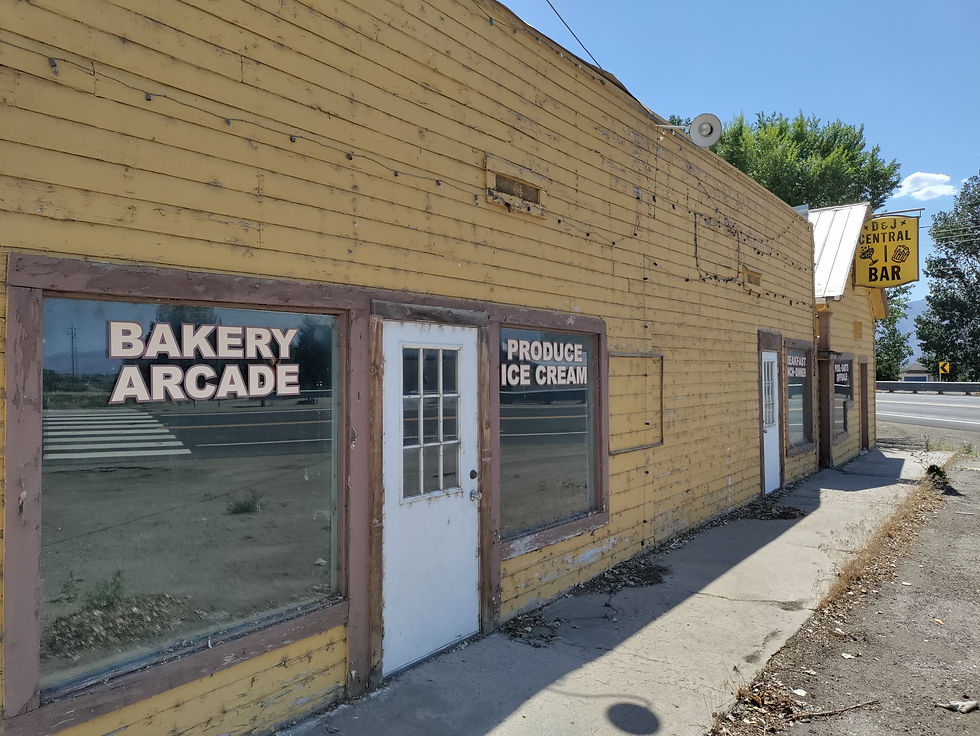
Under the encroaching haze from Tamarack to the south, we cruise through flat brown pastureland, cattle clustering in the sparse shade. And we first encounter Smith. It seems a pleasant place to live: respectable cottonwoods shade comely old houses festooned with American flags and livened with annuals blooming in concrete planters. The valley’s main east-west artery, Nevada State Highway 208, curves south at Smith; in the crook of the elbow is Renner’s True Value and the vacant building that used to house the Central Bar, also known as Central Junction, also known (to locals) as the Central.
Down past the Central, south around the curve, we arrive at our first post office of the day. It was founded, we discover, in 1892, which means it’s a relic of the agency model upon which rural 19th-century post offices ran. In his new book Paper Trails: The US Post and the Making of the American West, Cameron Blevins describes the agency model as follows:
Unlike today, most of the nation’s postal infrastructure was not publicly owned or operated in the 19th century. Outside of big cities, the US Post did not erect its own stand-alone post office buildings, buy its own fleet of horse-drawn vehicles, or hire its own staff of salaried civil servants. Instead, it appointed local private agents to act on its behalf. It contracted with stagecoach companies to shuttle bags of mail between post offices and paid merchants or other business owners to sell stamps and distribute letters from inside their stores or homes. These responsibilities were rarely a full-time pursuit so contractors and postmasters simply added their mail duties on top of their primary occupation. (12)
Given Smith Valley’s location and the age of the post office there, we feel safe in assuming that it began under this agency model – a contract between the US Post and a local businessperson. Perhaps it may even have been a family concern: a plaque hanging inside on the pressed-wood paneling thanks “The CARTER FAMILY Who Maintained This Facility For 66 Years”. The Smith office has been in operation for 129 years; the Carters cast a long shadow.

The building itself savors of the West, quintessentially rather than ostentatiously. The bright-white paint of its wooden siding has chipped and peeled in spots, and the ornate blue sign with its white gothic lettering lists the building’s elevation along with other pertinent details. The familiar flagpole flies the stars and stripes above a POW/MIA flag. A massive cottonwood in the neighboring lot shades part of the post office. The high desert sun bores down through the haze. The parking lot is empty. I leave the air conditioning running in the car and head inside.

The coziness, shall we say, of the outside shapes the inside too. The ceilings are so low as to brush my scalp. There’s not much waiting-room in the lobby, though there likely aren’t long queues out here, either. It’s warm, too: very warm. The single wall-mounted air conditioner, I discover, has been on the fritz for the last several days. And – as a sweaty fulfillment of Murphy’s Law – today the furnace turned on, for no apparent reason.

When I called the Smith post office the day before our excursion, to ask if they’d be open, the voice on the other end of the line – Cherokee, her name was – paused a moment before answering. Yes, she said. I could hear the wry ellipsis. Then, not sure why we wouldn’t be. In person, she lives up to her telephone persona, but her eyes twinkle as she fans herself behind the plexiglass shield at her retail counter. All in all, my conversation with Cherokee was one of the most purely fun interactions I’ve had with an employee of the United States Postal Service.

Cherokee isn’t the postmaster here. The Smith PO doesn’t have a postmaster, not any more; it’s experienced the same contraction in hours that Jola mentioned, in Gerlach. But Cherokee is the only one who works in the Smith office. While she may not have the title of postmaster, or the paycheck, she fulfills the community role to a T.

Part of her success in running this office, she says, is her personality. She’s outgoing, knows everybody, and connects with everybody. (As I mentioned: she’s so much fun to talk to.) The work is pleasant; the customers are nice. I wouldn’t last in a big post office, she grins. She’s lasted here, though; she’s worked in Smith full-time, or almost full-time for a while. Seven years? Eight years? Nine? Ten? she muses aloud. She lives out here, too, north of town, with her dogs. Cherokee matches her post office: both solidly, if a bit unexpectedly, rooted in the community.
When I ask her how she likes working here, there are two answers. When here means Smith, she answers positively. Being the sole full-time(ish) employee at the Smith PO is good, she says. People take care of each other, and when I ask her about retirement, later in our conversation, she says brightly, this is my retirement!
Naturally, her answer is more complicated when here means the USPS. She appreciates that hers is a union job, because it gives her security she isn’t used to having. She works with people who are, in her phrase, generally nice. But – in another colorful phrase – there are too many chiefs and not enough Indians in the USPS. I’ve heard this tune before, at other post offices, a disappointment at the meddling of distant administrative types. Cherokee offers a persuasive solution to the problem: management at every level should have post office experience. In other words, promotion should be wholly internal. All the way to the top? I ask her, intrigued. She nods, emphatically. All the way to the very top. I try, and fail, to imagine Louis DeJoy working the retail window at the Smith post office.

Before we head out of town, I ask Cherokee another of my regular questions: how long have you been with the USPS, and where were you before this? Her answer makes an unexpected connection. Before coming on full-time at Smith – well, it’s not full time because we’re not open 40 hours a week, I’m really only working 35 hours, and I tell you that’s a lot all by myself! – she worked piecemeal at other post offices in the region. Wellington, where we’re headed next. Genoa. Coleville. Topaz.
Wait, hang on. Genoa, where we’ve been? And Greg in Genoa said something about Topaz closing down a few years back.
It did, says Cherokee. That building was busted up.
These people know each other. I know that. But there’s still something eye-opening about Cherokee’s path here, through a list of familiar places: Genoa, which we’ve visited, and Coleville, which we pass every time we travel down US-395, and Wellington, which we’re about to visit, and Topaz. I do some quick mental math. Topaz must have closed down in 2017 or 2018, then. I remember driving down 395 in ’15, and ’16, and, yes, I think I remember Topaz being open. Just off the highway. Shaded by big cottonwoods. A tiny building, even smaller than this one.

Cameron Blevins calls the invisible social links of the USPS a gossamer web, difficult to see even when you’re staring straight at it, practically invisible when you’re not paying attention. In the spark of this last question, the gossamer web of west-central Nevada’s post office ecosystem has caught the light just right, and we can see it - somewhat. I mull this over as I thank Cherokee again, and we depart. Perhaps Wellington will offer further illumination.


Comments